
Payroll management small businesses india
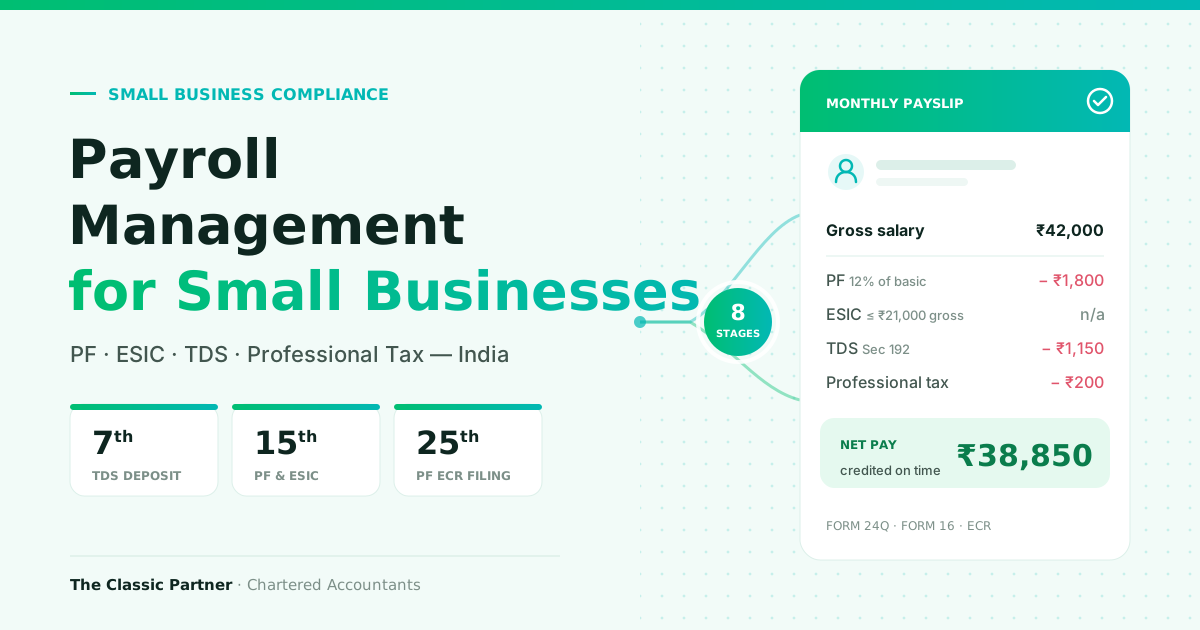
Payroll Management for Small Businesses in India: Everything You Need to Know | The Classic Partner The Classic Partner Chartered Accountants · Nashik Home/Blog/Payroll/Payroll Management for Small Businesses Small Business Compliance Series Payroll Management for Small Businesses in India: Everything You Need to Know PF, ESIC, TDS on salary, professional tax, compliance deadlines, common errors, and when to outsource — the complete payroll guide for Indian small businesses. Author The Classic Partner Published 8 September 2026 Category Payroll / HR Compliance In short Payroll is an eight-stage monthly process spanning five regulatory regimes — PF, ESIC, TDS on salary, professional tax, and labour law. The compliance burden is identical whether you have 5 employees or 500, and the costliest errors are wrong statutory deductions, late deposits, and quarterly or annual filing mistakes. For a 10–30 employee business, a professional payroll service typically costs ₹5,000–₹15,000 per month and removes that risk. Payroll is the moment every month when your obligations to your employees, the government, and the law all converge at the same deadline. Get it right, and your team is paid accurately and on time, your PF and ESIC contributions are deposited, your TDS is correctly deducted and reflected in your employees’ Form 26AS, and no penalty notices arrive. Get it wrong — even on a technicality — and the consequences range from employee trust issues to financial penalties to criminal proceedings under the EPF Act. For small business owners in India, payroll compliance is one of the most underestimated operational risks. The compliance burden is identical whether you have 5 employees or 500: the same laws apply, the same portals must be used, the same deadlines must be met, and the same penalties apply for non-compliance. This guide covers everything a small business in India needs to understand about payroll management — the legal obligations, the step-by-step process, the most common errors, and when it makes sense to hand it over to a professional service. The Classic Partner provides end-to-end payroll management services — PF, ESIC, TDS, PT, and payslips — so business owners can focus on growth. 01What Is the Complete Payroll Process for an Indian Small Business — Stage by Stage? Payroll is not a single act — it is an eight-stage monthly process. Each stage has its own inputs, outputs, and failure modes. The table below maps the complete payroll lifecycle with the most common errors at each stage: Payroll Stage What Happens Common Errors at This Stage 1. Data Collection Gather attendance, leave, overtime, new joinee and exit data, incentive approvals, investment declarations (Form 12BB) Missing new joinee data; late Form 12BB submission; not capturing leave without pay (LWP) 2. Gross Salary Computation Apply salary structure to compute each employee’s gross — basic, HRA, allowances, incentives; deduct LWP Incorrect LWP calculation; not adjusting gross for mid-month joiners/exits; miscalculating overtime 3. Statutory Deductions Calculate PF (12% of basic), ESIC (0.75% of gross), TDS (monthly instalment of annual tax), professional tax (state-specific) Wrong PF basis (using gross instead of basic+DA); ESIC on employees above ₹21,000 ceiling; TDS regime mismatch 4. Net Pay Computation Arrive at net take-home: gross minus all deductions; process salary transfers or cheques Arithmetic errors; bank account mismatches; not accounting for salary advances already paid 5. Payslip Generation Generate individual payslips showing all components and deductions; distribute to employees Payslips not issued; incorrect figures; missing statutory deduction breakdowns 6. Statutory Deposits Deposit PF, ESIC, TDS, and professional tax to respective authorities by due dates Missed deposit dates; depositing under wrong challan head; ESIC deposited after 15th 7. Monthly Returns File PF ECR (by 25th), ESIC return, payroll register update ECR with wrong UAN mapping; late filing; not matching ECR to actual deposit 8. Quarterly / Annual File TDS returns (Form 24Q quarterly); issue Form 16 (by 15 June); PF annual return; PT annual filing Errors in 24Q creating Form 26AS mismatches; delayed Form 16 causing employee ITR problems The most consequential errors — those that create regulatory exposure — occur at Stages 3, 6, and 8. Stage 3 (statutory deduction errors) affects PF accounts, ESIC eligibility, and employee tax calculations. Stage 6 (late deposits) triggers automatic interest and penalties from EPFO, ESIC, and the Income Tax Department. Stage 8 (quarterly and annual filing errors) creates mismatches in employees’ Form 26AS that affect their individual ITR filings — a direct impact on your employee relationship. 02Everything a Small Business Needs to Know About Provident Fund (PF) Compliance Provident Fund is the most operationally complex statutory benefit in Indian payroll — it involves monthly contributions, ECR filing, UAN management, and a contribution structure that requires careful understanding. The table below provides a complete reference on PF for small businesses: PF Topic Detail Governing Act Employees’ Provident Funds and Miscellaneous Provisions Act 1952 Applicability threshold Establishments with 20 or more employees (once covered, remains covered even below 20) Employee contribution 12% of basic wages + dearness allowance (DA) Employer contribution breakdown 3.67% to Employee Provident Fund (EPF) + 8.33% to Employee Pension Scheme (EPS) = 12% total. Plus 0.50% to EDLI and ~0.50% admin charges Wage ceiling for mandatory PF ₹15,000/month. Mandatory contribution on wages up to ₹15,000. Voluntary on higher wages (both parties must agree for wages above ₹15,000) UAN (Universal Account Number) Each employee has a UAN that stays with them across employers. Employer must activate UAN and link Aadhaar before first ECR. Monthly deadline Contribution must be deposited by 15th of the following month. ECR must be filed within 25 days of month-end. EPFO Portal Unified Member Portal (unifiedportal-emp.epfindia.gov.in) — all filings, payments, and UAN management Interest on EPF Currently 8.25% p.a. (as notified by EPFO for 2023-24; check for current year). Tax-free up to ₹2.5L contribution per year. Late payment consequence Interest @ 12% p.a. + damages: 5% for delay up to 2 months; 10% for 2–4 months; 15% for 4–6 months; 25% beyond 6 months Three practical points that trip up small businesses most often on PF: The 20-Employee Threshold Is Cumulative and
Earnings Per Share (EPS): How to Calculate Basic and Diluted EPS Under Ind AS 33

Earnings Per Share (EPS): How to Calculate Basic and Diluted EPS Under Ind AS 33 The Classic Partner Chartered Accountants · Nashik Home/Blog/Accounting Standards/EPS Under Ind AS 33 Accounting Standards Earnings Per Share (EPS): How to Calculate Basic and Diluted EPS Under Ind AS 33 Master the calculation of basic and diluted EPS under Ind AS 33 — weighted average shares, ESOP dilution, convertible instruments, and common errors to avoid. Author The Classic Partner Published 1 September 2026 Category Accounting Standards In short Earnings per share is the metric that moves stock prices. When a listed company announces quarterly results, the EPS number — not revenue, not EBITDA, not cash flow — is the figure that analysts compare against consensus estimates and that headlines report. Under Ind AS 33, every company whose shares trade on a stock exchange must calculate and present both basic EPS and diluted EPS on the face of the statement of profit and loss. Earnings per share is the metric that moves stock prices. When a listed company announces quarterly results, the EPS number — not revenue, not EBITDA, not cash flow — is the figure that analysts compare against consensus estimates and that headlines report. A company that beats its EPS estimate by ₹0.50 sees its stock rally; a company that misses by the same amount sees it fall. This outsized influence exists because EPS is the denominator in the price-to-earnings (P/E) ratio — the most widely used valuation multiple in equity markets — and because it measures the one thing every shareholder ultimately cares about: how much profit the company generated for each share they own. Under Ind AS 33, every company whose shares trade on a stock exchange must calculate and present both basic EPS and diluted EPS on the face of the statement of profit and loss. Getting these numbers wrong is not an abstract accounting error — it is a market-moving misstatement that triggers regulatory scrutiny, analyst distrust, and potential enforcement action by SEBI. The Classic Partner provides financial reporting services that include Ind AS 33 compliance, EPS computation for complex capital structures, and dilutive instrument analysis for listed and pre-IPO companies. 01How Do You Calculate the Weighted Average Number of Shares for Basic EPS? The denominator of the basic EPS formula — the weighted average number of ordinary shares outstanding — is where most of the computational complexity lies. It is not simply the number of shares outstanding at the end of the year. Ind AS 33 requires a time-weighted average that reflects the period during which each share was entitled to participate in the entity’s profits. The Starting Point — Shares Outstanding at the Beginning of the Period The calculation begins with the number of ordinary shares outstanding on the first day of the reporting period. For a company with a March year-end, this is the shares outstanding on 1 April. Adjusting for Shares Issued During the Period Shares issued during the year are weighted by the fraction of the year for which they were outstanding. If a company issues 4 crore new shares on 1 October in a March year-end company, those shares are weighted 6/12 (six months out of twelve). Shares issued on 1 January are weighted 3/12. The key principle is that shares are included from the date they become entitled to participate in dividends, which is typically the date of allotment. Consider an example: Company XYZ had 20 crore shares outstanding on 1 April 2025. On 1 July 2025, it issued 4 crore shares through a rights issue. On 1 January 2026, it bought back 2 crore shares. The weighted average is: (20 crore × 3/12) + (24 crore × 6/12) + (22 crore × 3/12) = 5 crore + 12 crore + 5.5 crore = 22.5 crore shares. Bonus Shares and Share Splits — Retroactive Adjustment Bonus issues and share splits require special treatment because they increase the number of shares without bringing additional resources into the company. Ind AS 33 treats these as if they had occurred at the beginning of the earliest period presented — not from the date of issue. This means that when a company issues bonus shares in January 2026, the weighted average for both FY 2025–26 and the comparative FY 2024–25 must be recalculated with the bonus element applied from the start. This retroactive adjustment ensures that EPS figures remain comparable across periods. For example, if the company in the earlier example also issues 1:1 bonus shares on 15 February 2026, every share figure in the weighted average calculation — including the opening balance and every subsequent change — must be doubled, and the prior year’s EPS must be restated accordingly. Rights Issues Below Market Price — The Bonus Element When a company issues shares through a rights issue at a price below the market price, the rights issue contains a bonus element — the difference between the fair value per share before the rights issue and the theoretical ex-rights price. Ind AS 33 requires this bonus element to be separated and treated as if it were a bonus issue (retroactive adjustment), while the remaining portion is treated as a regular share issue (time-weighted from the date of issue). The theoretical ex-rights price is calculated as: (Total fair value of shares before rights issue + Total proceeds from rights issue) ÷ Total number of shares after rights issue. This adjustment is often overlooked and is a frequent source of error in EPS calculations. Companies going through rights issues benefit from professional Ind AS advisory to ensure the bonus element is correctly identified and applied. 📋 Note Share buybacks reduce the weighted average number of shares from the date of cancellation, not from the date of the board resolution or the date of payment. The shares are excluded from the weighted average only when they are legally cancelled. If shares are repurchased and held as treasury shares (where permitted), they are excluded from the weighted average from the date of
Ind AS 112: Disclosure of Interests in Other Entities Explained
Ind AS 112 Explained: Disclosure of Interests in Entities Classic Partner LLP Chartered Accountants · Nashik Home/Blog/Accounting & Compliance/Ind AS 112 Accounting & Compliance Ind AS 112: Disclosure of Interests in Other Entities Explained Ind AS 112 explained through the judgement chain: control, joint control or significant influence, and the disclosures each one triggers. Author Classic Partner LLP Published 27 August 2026 Category Accounting & Compliance In short Ind AS 112 governs the disclosure of interests in other entities, requiring an entity to disclose information that lets a reader evaluate the nature of, and the risks arising from, its interests in subsidiaries, joint arrangements, associates and unconsolidated structured entities. It prescribes no recognition and no measurement — the note fails more often than the arithmetic, because every figure it asks you to publish was decided earlier, by a judgement about what kind of relationship you have with each entity. Ind AS 112 governs the disclosure of interests in other entities, requiring an entity to disclose information that lets a reader evaluate the nature of, and the risks arising from, its interests in subsidiaries, joint arrangements, associates and unconsolidated structured entities, and the effect of those interests on its financial position, performance and cash flows. It prescribes no recognition and no measurement. That is why the note fails more often than the arithmetic. Every figure it asks you to publish was decided earlier, by a judgement about what kind of relationship you have with each entity. Where that judgement is wrong or undocumented, a tidy note still misstates the group. This guide follows the order the work actually happens: classify first, disclose second. 01Why Does Ind AS 112 Exist? It closes the gap between what a parent’s own balance sheet shows and what the group behind it controls, funds or stands behind. A parent can hold twenty per cent and still control the board, guarantee borrowings of an entity it does not consolidate, or absorb the returns of a vehicle it owns no share of. In each case the reported numbers alone mislead. The standard answers with two things: the significant judgements behind the group’s conclusions, and enough detail on each category of interest for a reader to see the exposure. The information disclosures cover interests in subsidiaries, joint arrangements and associates, and unconsolidated structured entities, each with its own required content. It also carries a provision that defeats checklists. Where the prescribed disclosures, with those required by other standards, do not achieve that objective, the entity must disclose whatever further information is necessary. That call belongs to the entity, which is why the note repays review as part of audit and assurance work rather than a final-week tidy-up. 02Which Relationship Do You Actually Have? Everything downstream depends on this, and it is settled by three other standards rather than by this one. Relationship The Test Standard Result Control Power over the investee, exposure to variable returns, and ability to use that power to affect them — all three. Ind AS 110 Consolidate Joint control Decisions on relevant activities need unanimous consent of the sharing parties. Ind AS 111 Joint operation or joint venture Significant influence Power to participate in financial and operating policy decisions, without controlling them. Ind AS 28 Equity method None of these A passive investment. Ind AS 109 Financial asset Two traps recur. The first is reading the shareholding as the answer: control turns on power over the relevant activities, so a minority holder with contractual rights can control and a majority holder can fail to. The second is the twenty per cent presumption in Ind AS 28, which can be rebutted where clearly demonstrated, and which cuts both ways — significant influence can exist below twenty per cent through board representation or participation in policy-making. 03What Does Ind AS 112 Require You to Disclose? Once the relationship is settled, the package follows almost mechanically. Interests in subsidiaries attract the fullest set. If the Relationship Is The Disclosures Centre On A subsidiary Composition of the group, subsidiaries carrying material non-controlling interests, restrictions on using group assets, and the effect of ownership changes or loss of control. A joint operation Name, nature of the relationship, place of business and participating share; the operator recognises its own assets, liabilities, revenue and expenses. A joint venture Name, ownership proportion, measurement basis, summarised financial information where material, commitments and contingent liabilities. An associate As for a joint venture, plus fair value where a quoted market price exists; immaterial associates disclosed in aggregate. An unconsolidated structured entity Nature and extent of the interest, risks arising, maximum exposure to loss, and support given without an obligation to give it. Alongside these sit the significant judgements, which apply whatever the category: the judgements and assumptions made in concluding that control, joint control or significant influence exists, in classifying a joint arrangement structured through a separate vehicle, and in determining that the entity is an investment entity where relevant. 📋 Note Write the judgement down when the conclusion is reached, not when the note is drafted. A control conclusion reconstructed nine months later from memory is the weakest paper in any audit file, and it is the first item a reviewer turns to where voting rights and accounting treatment point in different directions. 04Which Disclosures Are Most Often Missed? Five omissions account for most review points on subsidiaries, joint arrangements and associates, and none involves a difficult calculation. Reasoning behind a contested control conclusion. Where control is asserted on half the voting rights or fewer, or denied on more than half, the basis must be given. This is the item most often absent. Restrictions on moving money round the group. Statutory, contractual and regulatory limits on accessing or using assets and settling liabilities. Loan covenants and shareholder agreements are where these hide. Summarised financial information for material associates. Groups give it for subsidiaries and forget each individually material associate and joint venture needs it too. Non-controlling interests detail. Beyond the balance sheet figure: the proportion held,
IFRS vs US GAAP: Key Differences Every Business and Finance Professional Must Know
IFRS vs US GAAP: Key Differences Every Business and Finance Professional Must Know Classic Partner LLP Chartered Accountants · Nashik Accounting & Financial Reporting IFRS vs US GAAP: Key Differences Every Business and Finance Professional Must Know Where the two frameworks genuinely diverge, why both are redesigning the income statement for 2027, and what that means if you report under either. Author Classic Partner LLP Published 18 August 2026 Category Accounting & Financial Reporting In short IFRS is principles‑based; US GAAP is rules‑based — almost every technical difference between them is a downstream consequence of that one design choice. Few Indian entities apply US GAAP as a statutory framework, but many prepare a US GAAP reporting pack for a parent or investor. And from 2027, both frameworks are redesigning how the income statement is presented — at the same time, in different directions. The IFRS vs US GAAP comparison is usually presented as a list of technical differences, and that list is worth having. But it misses the point that explains most of the differences on it. IFRS is principles‑based: it sets out a framework and expects preparers to apply judgement. US GAAP is rules‑based: it sets out detailed and often industry‑specific requirements, with bright lines, exceptions and interpretive guidance layered over decades. Almost every divergence between the two is a downstream consequence of that single design choice. For finance professionals in India the practical relevance is narrower than the topic suggests, but real. Very few Indian entities apply US GAAP as a statutory framework. Many prepare a US GAAP reporting pack because a parent, an investor or a group auditor requires one, while continuing to file Indian statutory accounts. And something is about to change for everyone: both frameworks are redesigning how the income statement is presented, with effect from 2027, which makes the current financial year a comparative year rather than a quiet one. 01What Is the Difference Between IFRS vs US GAAP? IFRS Accounting Standards are issued by the International Accounting Standards Board and required or permitted in well over a hundred jurisdictions. US GAAP is issued by the Financial Accounting Standards Board and codified in the Accounting Standards Codification, and it applies to entities reporting in the United States. Two standard setters, two governance structures, and two very different drafting philosophies. The philosophical difference shows up in length as much as in substance. A principles‑based standard states an objective and a small number of requirements, and expects the preparer and auditor to reason to an answer. A rules‑based standard anticipates the situations that will arise and prescribes the treatment for each. The first produces financial statements that better reflect economic substance but vary more between companies; the second produces greater consistency at the cost of complexity, and creates the incentive to structure transactions just outside a bright line. A third practical difference is regulatory rather than technical. The United States Securities and Exchange Commission permits foreign private issuers to file financial statements prepared under IFRS without reconciling them to US GAAP, while domestic registrants must use US GAAP. The two frameworks coexist within the same capital market rather than competing for it. Where a business needs help determining which framework applies to it and why, that is where our accounting and assurance services usually begin. 02Which Framework Applies to Your Business, and When Do Both? For an Indian company the statutory position is settled: financial statements are prepared under Indian Accounting Standards or under the Accounting Standards notified under company law, depending on size and listing status. Neither IFRS nor US GAAP is the statutory framework. So the question is never which one replaces Indian standards, but whether a second framework applies on top for group purposes. Four situations bring US GAAP into an Indian finance function: a subsidiary of a United States parent preparing a consolidation pack; an Indian entity inside a group listed on a US exchange; a captive or global capability centre whose parent reports under US GAAP; and an Indian business raising capital from American investors who expect familiar reporting. In each case the entity maintains Indian statutory accounts and produces a separate reporting output — a conversion exercise rather than a second set of books. Note Indian Accounting Standards are converged with IFRS but not identical to it, because India retained a defined set of carve‑outs. An Indian entity converting statutory figures for a US parent is therefore bridging two gaps at once, not one: from Indian standards to IFRS, and from IFRS to US GAAP. Treating it as a single reconciliation is a common and expensive simplification. 03Where Do IFRS vs US GAAP Differ on Inventory, Assets and Impairment? The differences below change reported numbers rather than presentation, and they are the ones a reconciliation schedule has to carry every period. Area IFRS US GAAP Inventory costing LIFO prohibited; specific identification, FIFO or weighted average only. LIFO permitted, and widely used for its tax effect in periods of rising prices. Inventory write‑downs Reversed when net realisable value recovers. Reversal prohibited; the write‑down is permanent. Property, plant & equipment Cost or revaluation model, applied by class of asset. Historical cost only; revaluation is not permitted. Component depreciation Required where components have different useful lives. Permitted but uncommon in practice. Development costs Capitalised once recognition criteria are met. Generally expensed as incurred, narrow exceptions for software. Impairment of long‑lived assets Single‑step test against recoverable amount, using discounted cash flows. Two‑step test beginning with an undiscounted cash flow recoverability screen. Reversal of impairment Permitted for most assets; prohibited for goodwill. Prohibited for assets held for use. Investment property Separate asset class; cost or fair value model available. No separate category outside investment companies. Provisions Recognised where an outflow is more likely than not. Recognised where an outflow is probable — a higher threshold in practice. Two of these deserve emphasis because their effects persist. Impairment reversal means an asset written down in a difficult year and recovering afterwards carries a different value under each